
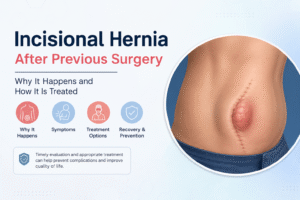
A lump or swelling appearing around an old surgical scar can be easy to dismiss, especially if the original operation happened months or even years ago. However, a bulge that becomes more noticeable when you stand, cough, strain or lift something may be an incisional hernia.
An incisional hernia develops when part of the abdominal wall becomes weak at the site of a previous surgical incision, allowing abdominal tissue or, sometimes, a portion of the intestine to push through the weakened area. It can occur after both major open abdominal operations and, less commonly, minimally invasive procedures.
The condition may initially cause little or no discomfort, but an incisional hernia can gradually increase in size and may eventually cause pain, difficulty with daily activities or complications.
For patients who have noticed a new swelling near an old operation scar, understanding why incisional hernias occur, how they are diagnosed and when surgery may be recommended is important.
What Is an Incisional Hernia?
An incisional hernia is a type of abdominal wall hernia that develops through or near the site of a previous surgical incision.
During abdominal surgery, the layers of the abdominal wall are opened and then closed. Healing normally restores the strength of these tissues. If the abdominal wall does not regain adequate strength, a weak area may remain. Over time, pressure from inside the abdomen can push tissue through this weakness, producing a bulge.
The swelling may be:
- Visible while standing but less noticeable when lying down
- More prominent when coughing or straining
- Soft and painless initially
- Associated with discomfort, pulling or pain as it becomes larger
Incisional hernias can develop months or even years after the original surgery, so the absence of symptoms immediately after an operation does not completely rule out a future hernia.
Why Does an Incisional Hernia Develop After Surgery?
Having abdominal surgery does not automatically mean that a person will develop an incisional hernia. Several factors can affect how well the abdominal wall heals and how much stress is placed on the repaired tissue.
- Weakness at the previous surgical site
The incision creates an area where the normal layers of the abdominal wall have been divided and subsequently repaired. If the repaired tissue remains weaker than the surrounding abdominal wall, a hernia can eventually develop.
- Wound infection
An infection involving the surgical wound can interfere with normal tissue healing and may increase the likelihood of weakness developing at the incision.
- Increased abdominal pressure
Repeated or prolonged increases in pressure inside the abdomen can place additional stress on a weakened surgical site. Chronic coughing, constipation and repeated straining are examples of situations that can increase abdominal pressure.
- Excess body weight
Higher body weight can increase mechanical stress on the abdominal wall and may also affect wound healing and surgical risk.
- Smoking
Smoking can interfere with tissue healing and is an important modifiable risk factor to address before hernia surgery.
- Poor wound healing
Conditions or circumstances that impair healing can contribute to weakness at the surgical site.
- Repeated abdominal surgery
Patients who have undergone more than one abdominal operation may have additional scar tissue and changes in the abdominal wall, which can make subsequent hernia treatment more complex.
It is important to remember that an incisional hernia is not necessarily the result of something a patient did incorrectly after surgery. Multiple factors can influence how an abdominal incision heals.
What Does an Incisional Hernia Look and Feel Like?
The most common sign is a bulge or lump near a previous surgical scar.
You may notice that the swelling:
- Appears or becomes larger when you cough
- Increases when lifting or straining
- Becomes more prominent after standing for a long time
- Reduces or disappears when you lie down
- Causes a dragging or pulling sensation
- Becomes painful as the hernia increases in size
Some incisional hernias may remain relatively painless, which is one reason people sometimes ignore them.
A painless lump should not automatically be assumed to be harmless. A surgeon can assess whether the swelling is actually an incisional hernia and determine whether treatment is appropriate.
Can an Incisional Hernia Go Away on Its Own?
In most cases, an established incisional hernia does not simply disappear because the weakened abdominal wall does not spontaneously return to its original strength.
Small, minimally symptomatic hernias may sometimes be monitored depending on the individual patient’s circumstances. However, the appropriate approach depends on factors such as the size and location of the defect, symptoms, general health and risk of complications.
A surgical consultation is therefore useful even when the swelling is not painful.
When Should You See a Surgeon?
You should consider a surgical evaluation if you have:
- A new lump near an old abdominal surgical scar
- Increasing swelling at the scar
- Pain or discomfort around the swelling
- Difficulty performing normal physical activities
- A hernia that is becoming progressively larger
- A swelling that does not reduce when lying down
- Recurrent symptoms after previous hernia repair
Early assessment can help determine the size and characteristics of the abdominal wall defect and whether observation or surgical repair is appropriate.
How Is an Incisional Hernia Diagnosed?
Diagnosis usually begins with a detailed medical history and physical examination.
The surgeon may ask:
- What abdominal surgery did you previously have?
- When did you first notice the swelling?
- Does it become larger when standing or coughing?
- Does it reduce when you lie down?
- Is there pain or tenderness?
- Has the swelling changed in size?
- Have you had a previous hernia repair?
During examination, the surgeon may assess the swelling while you are standing, lying down and sometimes while coughing or straining.
Imaging tests
Not every patient requires imaging. However, an ultrasound or CT scan may be recommended when the diagnosis is uncertain, the hernia is large or complex, or detailed information about the abdominal wall is needed for treatment planning.
CT imaging can be particularly useful when surgeons need to understand the size and location of the defect and the relationship of the hernia to surrounding structures.
Does Every Incisional Hernia Need Surgery?
Not necessarily.
The decision depends on the individual patient rather than simply the presence of a hernia.
Factors that may influence treatment include:
- Size of the hernia
- Location of the defect
- Symptoms and pain
- Whether the hernia is increasing in size
- Previous hernia repairs
- General health
- Body weight
- Smoking status
- Other medical conditions
- Risk of complications
- Impact on daily activities and quality of life
For some patients, careful observation may be reasonable. For others, particularly those with symptoms or a progressively enlarging hernia, surgical repair may be recommended.
The European Hernia Society has published evidence-based guidance addressing the diagnosis and management of incisional hernias, highlighting the importance of individualized assessment and appropriate surgical planning.
How Is an Incisional Hernia Treated?
When surgery is recommended, the primary objective is to restore the strength and function of the abdominal wall and reduce the risk of recurrence.
Depending on the hernia and patient, repair may be performed through:
Open incisional hernia repair
Open surgery involves an incision over or near the hernia. The surgeon identifies the defect, returns protruding tissue to its appropriate position and reconstructs the abdominal wall.
A surgical mesh may be used to reinforce the repair, depending on the size, location and characteristics of the hernia.
Laparoscopic or minimally invasive repair
In selected patients, an incisional hernia can be repaired using minimally invasive techniques through smaller incisions.
The choice between open and minimally invasive approaches is not simply about which technique is newer or better. It depends on the size and location of the hernia, previous operations, scar tissue, abdominal wall anatomy, patient factors and the surgeon’s assessment.
Abdominal wall reconstruction
Large, complex or recurrent incisional hernias may require a more advanced abdominal wall reconstruction rather than a straightforward repair.
The surgical strategy may involve reconstructing the abdominal wall layers and positioning mesh in an appropriate anatomical plane.
Why Is Mesh Used in Incisional Hernia Repair?
One of the most common questions patients ask is: “Will I need mesh for my hernia surgery?”
Mesh is a medical implant designed to reinforce the abdominal wall and provide additional strength to the repair.
The decision to use mesh, the type of mesh and its position are determined by the characteristics of the hernia and the surgical technique being used.
Mesh is not appropriate in exactly the same way for every patient. The surgeon considers the size and location of the defect, tissue quality, previous operations, contamination or infection risk and other individual factors.
Patients should discuss the expected benefits and potential risks of mesh with their surgeon before surgery.
What Happens If an Incisional Hernia Is Left Untreated?
An incisional hernia does not always become an emergency. Some remain stable and cause minimal symptoms.
However, a hernia may enlarge over time and become increasingly uncomfortable. In some cases, abdominal contents can become trapped within the hernia.
Rare but serious complications include bowel obstruction and strangulation, in which the blood supply to trapped tissue is compromised. These situations require urgent medical attention.
Warning Signs of a Complicated Hernia
Seek urgent medical attention if a known or suspected hernia is associated with:
- Sudden or severe abdominal pain
- A swelling that becomes very painful
- A lump that suddenly becomes firm or cannot be pushed back
- Persistent vomiting
- Increasing abdominal distension
- Difficulty passing stool or gas
- Fever or feeling acutely unwell
- Skin changes over the swelling
These symptoms can indicate obstruction or strangulation and should not be ignored.
What Is Recovery Like After Incisional Hernia Surgery?
Recovery varies considerably depending on the size of the hernia, surgical technique and the patient’s overall health.
After surgery, patients are generally encouraged to gradually return to movement and everyday activities according to their surgeon’s instructions.
Recovery may involve:
- Managing discomfort during the initial period
- Keeping the surgical wound clean and monitored
- Gradually increasing walking and daily activity
- Following instructions regarding lifting and exercise
- Attending follow-up appointments
- Maintaining a healthy body weight
- Avoiding smoking
There is no single recovery timeline that applies to every incisional hernia repair. A large abdominal wall reconstruction, for example, may require a different recovery plan from a smaller repair.
Can an Incisional Hernia Come Back After Surgery?
Yes. Recurrence is a recognized possibility after incisional hernia repair.
The risk depends on several factors, including the size and complexity of the hernia, previous repairs, tissue quality, patient-related factors and the surgical technique.
This is why successful hernia treatment is not simply about closing the visible hole. Proper assessment of the abdominal wall and choosing an appropriate repair strategy are important parts of reducing recurrence risk.
Can You Prevent an Incisional Hernia?
Not every incisional hernia can be prevented. However, several measures can support healthy abdominal wall healing and may reduce modifiable risks.
These include:
- Maintaining a healthy body weight
- Avoiding smoking
- Managing conditions that affect wound healing
- Treating persistent cough
- Avoiding prolonged constipation and excessive straining
- Following post-operative activity instructions
- Maintaining good nutrition
- Attending follow-up appointments when advised
Patients who have previously developed an incisional hernia should also discuss their risk factors with their surgeon before any future abdominal surgery.
Incisional Hernia vs Other Types of Hernia
An incisional hernia is different from common groin or belly-button hernias.
| Type of hernia | Typical location |
| Incisional hernia | At or near a previous surgical incision |
| Inguinal hernia | Groin |
| Umbilical hernia | Around the belly button |
| Femoral hernia | Upper thigh/groin region |
| Epigastric hernia | Upper abdominal wall |
The location and history of previous surgery are important clues when assessing a new abdominal lump.
Frequently Asked Questions About Incisional Hernia
How long after surgery can an incisional hernia develop?
An incisional hernia can develop months or even years after an abdominal operation. A new swelling around an old surgical scar should therefore be assessed even if the original surgery was performed a long time ago.
Is an incisional hernia painful?
It can be, but not always. Some patients notice only a visible bulge, while others experience pain, pressure, pulling or discomfort, particularly with coughing, lifting or physical activity.
Can exercise make an incisional hernia worse?
Activities that significantly increase abdominal pressure may make the bulge more noticeable or aggravate symptoms. Patients with a known hernia should discuss appropriate exercise and lifting limits with their surgeon rather than stopping all physical activity without medical advice.
Is laparoscopic surgery possible for an incisional hernia?
Minimally invasive repair may be appropriate for selected patients. However, it is not suitable for every hernia. Previous operations, the size and location of the defect, scar tissue and other factors influence the surgical approach.
Is mesh always required for incisional hernia surgery?
Not every repair is identical. Mesh may be recommended to reinforce the abdominal wall, particularly depending on the size and characteristics of the defect. The decision should be individualized.
Can an incisional hernia be treated without surgery?
Some small or minimally symptomatic hernias may be monitored under medical supervision. However, an established abdominal wall defect generally does not simply heal itself. A surgeon can help determine whether observation or repair is appropriate.
Is an incisional hernia dangerous?
Many incisional hernias do not cause an immediate emergency. However, complications such as bowel obstruction or strangulation can occur. Sudden severe pain, a painful irreducible swelling, vomiting or other acute symptoms require urgent assessment.
When Should You Consult a General Surgeon?
If you have noticed a new swelling around a previous abdominal surgical scar, don’t assume that it is simply part of the scar.
An examination by an experienced general and laparoscopic surgeon can help determine whether the swelling is an incisional hernia and whether it requires monitoring, further imaging or surgical repair.
The right treatment depends on the individual patient, the size and location of the hernia, previous surgeries and the condition of the abdominal wall.
Conclusion
An incisional hernia is a relatively common complication that can occur at the site of a previous abdominal surgical incision. It may begin as a small, painless bulge but can gradually become larger or symptomatic.
The good news is that incisional hernias can be evaluated and treated using a range of modern surgical approaches. Depending on the individual case, treatment may involve observation, open repair, minimally invasive surgery or more complex abdominal wall reconstruction.
If you have developed a swelling, pain or bulge around an old surgical scar, getting it assessed by a qualified surgeon is the best way to understand what is causing it and whether treatment is necessary.
This article is for general information and does not replace an examination or personalized medical advice from a qualified surgeon.
SEO Elements
Primary keyword:
Incisional hernia
Secondary keywords:
- Incisional hernia after surgery
- Incisional hernia treatment
- Incisional hernia repair
- Incisional hernia symptoms
- Incisional hernia causes
- Incisional hernia surgery
- Incisional hernia mesh repair
- Laparoscopic incisional hernia repair
- Incisional hernia treatment in Faridabad
- Hernia surgeon in Faridabad
- Laparoscopic surgeon in Faridabad
Suggested SEO title:
Incisional Hernia After Surgery: Causes, Symptoms & Treatment
Meta description:
Learn why incisional hernias develop after surgery, their symptoms, diagnosis and treatment options including mesh, open and laparoscopic repair.
Suggested URL slug:
/incisional-hernia-after-surgery-causes-symptoms-treatment/
Suggested H1:
Incisional Hernia After Previous Surgery: Why It Happens and How It Is Treated
Suggested FAQ schema questions:
- How long after surgery can an incisional hernia develop?
- Is an incisional hernia painful?
- Can an incisional hernia be treated without surgery?
- Is mesh always required for incisional hernia repair?
- Can an incisional hernia come back after surgery?
- Is laparoscopic surgery possible for an incisional hernia?
- When is an incisional hernia an emergency?